
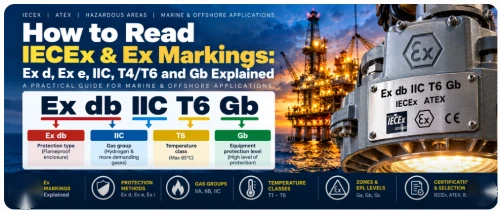
Learn how to read IECEx and explosion-protection markings, including Ex d, Ex e, Ex i, gas groups, temperature classes and equipment protection levels.
Understanding Explosion-Protected Equipment Markings
Electrical equipment installed in hazardous areas must be selected carefully to minimise the risk of igniting flammable gases, vapours or combustible dust.
For offshore oil and gas installations, FPSOs, chemical tankers, LNG facilities and other industrial environments, explosion-protected electrical equipment is commonly marked with a combination of letters and numbers.
For example:
Ex db IIC T6 Gb
At first glance, this marking may appear complicated. However, each element provides important information about the equipment's explosion-protection characteristics.
Understanding these markings is essential when selecting or replacing hazardous-area equipment, including:
-
Explosion-protected LED lighting
-
Junction boxes and enclosures
-
Cable glands and accessories
-
Motors and electrical equipment
-
Sensors and instrumentation
-
Control stations and switches
-
Electrical fittings and connectors
This guide explains the most common Ex markings and how to interpret them when purchasing equipment for marine and offshore applications.
1. What Does “Ex” Mean?
The marking Ex indicates that equipment uses one or more recognised explosion-protection techniques.
These techniques are designed to reduce the risk of electrical equipment becoming an ignition source in potentially explosive atmospheres.
Explosion-protected equipment may be assessed under standards from the IEC 60079 series, which cover electrical equipment and protection methods for explosive atmospheres.
Two important frameworks are:
IECEx: An international conformity assessment system for equipment and services used in explosive atmospheres.
ATEX: The European Union regulatory framework governing equipment and protective systems intended for potentially explosive atmospheres.
Although IECEx and ATEX often use closely aligned technical standards, they are not identical certification systems.
For a detailed comparison, read our related article:
IECEx vs ATEX: A Practical Guide to Explosion-Proof Equipment for Marine & Offshore Applications
2. How to Read an Ex Marking
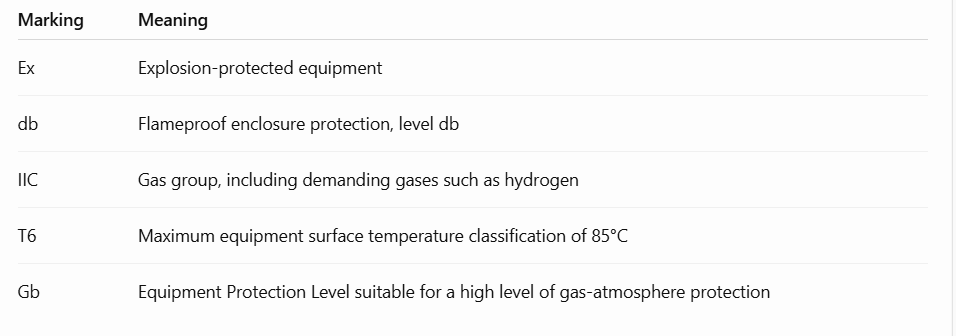
Consider the following example:
Ex db IIC T6 Gb
3. What Is Ex d or Ex db?
Ex d refers to flameproof enclosure protection.
This protection method allows electrical components capable of producing sparks or high temperatures to be housed inside a specially designed enclosure.
If an internal explosion occurs, the enclosure is designed to withstand the pressure and prevent flame transmission to the surrounding explosive atmosphere under its certified conditions.
Modern markings commonly include protection levels such as Ex db.
Typical Ex d applications
-
Explosion-protected lighting fixtures
-
Electric motors
-
Control equipment
-
Electrical switches
-
Certain junction boxes and enclosures
Important considerations
Flameproof equipment relies on specific enclosure construction and flamepath characteristics.
Therefore, the following must not be modified without appropriate authorisation:
-
Flameproof joints
-
Enclosure covers
-
Certified cable entries
-
Threaded connections
-
Sealing arrangements
-
Approved components
Using an incorrect cable gland or modifying the enclosure may compromise its explosion-protection integrity.
Ex d does not mean that the equipment is designed to withstand an explosion anywhere in the installation. It refers to a specific certified protection concept.
4. What Is Ex e or Ex eb?
Ex e refers to increased safety protection.
Unlike flameproof enclosures, increased safety equipment is designed to prevent arcs, sparks and excessive temperatures during the conditions covered by its protection concept.
Modern markings commonly include Ex eb and Ex ec, representing different protection levels.
Typical Ex e applications
-
Terminal boxes
-
Junction boxes
-
Certain electrical motors
-
Lighting equipment
-
Electrical connection assemblies
Increased safety protection may incorporate features such as:
-
Improved insulation
-
Secure electrical terminals
-
Suitable creepage and clearance distances
-
Temperature control
-
Protection against loose connections
Ex d vs Ex e
The main distinction is:
Ex d: Contains an internal explosion and prevents flame transmission to the surrounding atmosphere.
Ex e: Uses construction and design measures to avoid ignition-capable conditions.
Both methods are widely used in hazardous-area electrical equipment, but they are not interchangeable without technical assessment.
5. What Is Ex i – Intrinsic Safety?
Ex i refers to intrinsic safety.
This protection technique limits the electrical and thermal energy available in a circuit so that ignition cannot occur under the conditions specified by the applicable protection level.
Intrinsic safety is particularly useful for low-power instrumentation and control circuits.
Common applications
-
Pressure transmitters
-
Temperature sensors
-
Level measurement devices
-
Instrumentation systems
-
Communication and monitoring equipment
-
Process control circuits
Common protection levels include:
Ex ia
Ex ib
Ex ic
These provide different levels of protection and have different permitted hazardous-area applications.
For example, appropriately certified Ex ia equipment may be suitable for Zone 0 gas applications, whereas Ex ib is generally associated with Zone 1 and Ex ic with Zone 2.
However, the suitability of an intrinsically safe device depends on the complete circuit, including associated apparatus, wiring parameters and installation design.
An Ex i transmitter cannot automatically be connected to any ordinary power supply.
6. Understanding Gas Groups: IIA, IIB and IIC
Hazardous-area equipment is classified according to the explosive gas atmosphere for which it is suitable.
For Group II gas-atmosphere equipment, three commonly encountered subdivisions are:
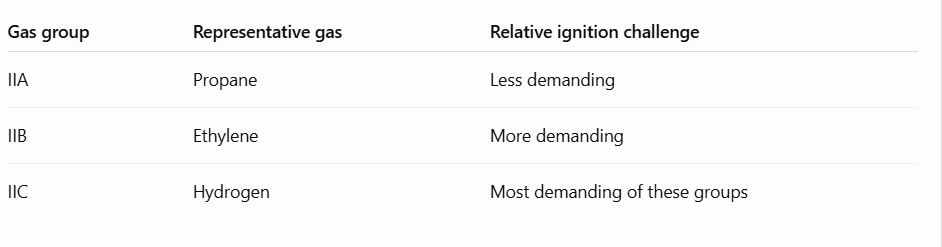
Equipment marked IIC is generally suitable for IIB and IIA gas-group applications, provided all other relevant conditions are satisfied.
However, equipment marked IIA should not be assumed suitable for IIB or IIC atmospheres.
Example
Suppose an offshore installation specifies equipment suitable for:
Gas Group IIC
A replacement LED fitting marked only Ex db IIB T6 Gb would not automatically satisfy the IIC requirement.
The gas-group marking must match the installation's hazardous-area specification.
Important: Gas group and hazardous-area zone are separate classifications. A higher gas group does not automatically mean the equipment is suitable for a more hazardous zone.
7. Understanding Temperature Classes: T1 to T6
Explosion-protected equipment must also control its maximum surface temperature.
This is important because a hot surface can ignite a flammable gas atmosphere even without an electrical spark.
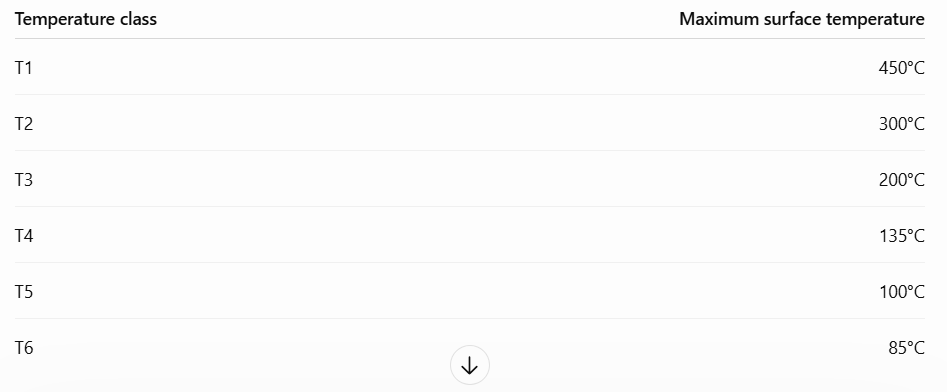
Temperature classes specify the maximum permitted surface temperature of equipment under the relevant certification conditions.
Ex Temperature Class Reference
T4 vs T6 – What's the Difference?
A T4 rating indicates a maximum surface temperature of 135°C.
A T6 rating indicates a maximum surface temperature of 85°C.
Therefore, T6 imposes a lower maximum surface-temperature limit.
This can make T6 equipment suitable for certain atmospheres where T4 equipment would not meet the temperature requirement.
However, a T6 marking does not automatically make equipment suitable for every hazardous area.
The gas group, Equipment Protection Level, ambient temperature and other certification conditions must also be considered.
Example
If the project specification requires:
Ex db IIC T6 Gb
A replacement marked:
Ex db IIC T4 Gb
does not automatically meet the requirement because the permitted maximum surface temperature is higher.
8. What Does Gb Mean? Understanding Equipment Protection Levels
Equipment Protection Level, or EPL, describes the level of protection provided by equipment against becoming an ignition source.
For explosive gas atmospheres, the commonly used EPLs are:
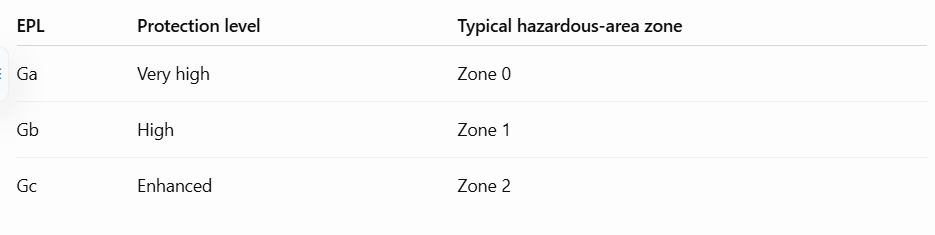
Equipment with a higher protection level may also be suitable for less demanding zones, subject to all other installation requirements.
Example
Ex db IIC T6 Gb
The final Gb indicates that the equipment provides a high level of protection for gas atmospheres and is generally suitable for Zone 1 applications.
This does not mean the equipment is automatically suitable for Zone 0.
Zone 0 generally requires equipment with EPL Ga.
9. What Are Zone 0, Zone 1 and Zone 2?
Hazardous areas are classified according to the likelihood and duration of an explosive atmosphere being present.
Zone 0
An explosive gas atmosphere is present continuously, for long periods or frequently.
Zone 1
An explosive gas atmosphere is likely to occur occasionally during normal operation.
Zone 2
An explosive gas atmosphere is not likely to occur during normal operation, but if it does occur, it will normally persist for only a short period.
Examples of offshore locations requiring hazardous-area assessment may include:
-
Hydrocarbon processing areas
-
Gas handling equipment
-
Pump and compressor areas
-
Tank vents
-
Fuel transfer locations
-
Chemical processing modules
The actual zone classification must come from the installation's approved hazardous-area classification documentation.
It should not be determined simply from the equipment's location or appearance.
10. How to Read ATEX Markings
Equipment certified under the European ATEX framework may display additional markings.
For example:
II 2G Ex db IIC T6 Gb
This can be interpreted as:
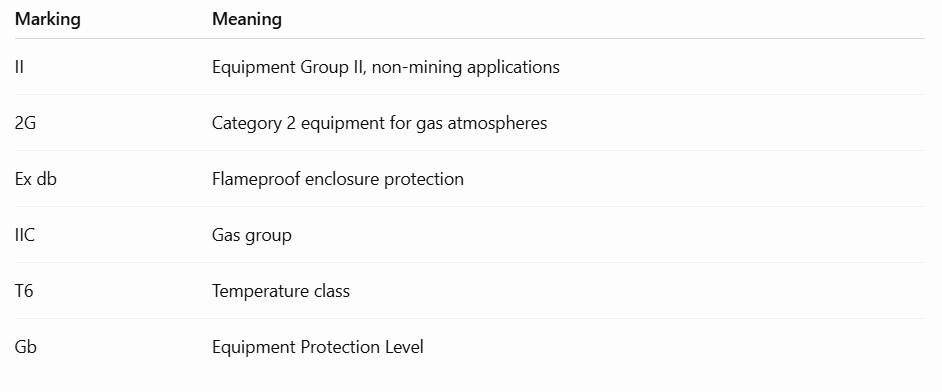
ATEX equipment markings may also include the CE mark, specific explosion-protection symbol and notified-body identification where applicable.
IECEx and ATEX documentation should not be treated as interchangeable without checking the actual certification requirements.
11. What About Dust Hazardous Areas?
Not all explosive atmospheres involve gas.
Some industrial environments contain combustible dust, which requires a different approach to equipment selection.
Dust-related markings may include:
Ex tb IIIC T85°C Db
Here:
-
Ex tb indicates protection by enclosure for dust atmospheres.
-
IIIC indicates conductive dust.
-
T85°C indicates the specified maximum surface temperature.
-
Db indicates the Equipment Protection Level for dust atmospheres.
Dust hazardous areas use Zones 20, 21 and 22, rather than gas Zones 0, 1 and 2.
Equipment certified for gas atmospheres is not automatically certified for combustible dust.
For offshore and marine applications, always verify whether the project requires gas protection, dust protection or both.
12. How to Check an IECEx Certificate
An Ex marking alone is not sufficient evidence that equipment meets the required specification.
For purchasing and replacement projects, buyers should request the actual certification documentation.
Important checks include:
Manufacturer and model number
The certificate must cover the exact equipment model or approved variant.
Certificate number
Confirm the IECEx Certificate of Conformity number.
Full Ex marking
Check the protection method, gas group, temperature class and EPL.
Ambient temperature
Some equipment is approved only within a specified ambient temperature range.
Special conditions of use
Certificates ending in X indicate that specific conditions of use must be considered.
Component certification
Certificates ending in U identify Ex components that are not independently certified as complete equipment for installation.
Certificate status
Check the current certificate and any revisions or schedules.
The official IECEx certificate database can be accessed through:
Always verify certificates using the official IECEx system rather than relying solely on a supplier's catalogue description.
13. Can Ex d Equipment Be Replaced with Ex e Equipment?
Not automatically.
Different explosion-protection techniques may be acceptable for the same hazardous-area classification, but the equipment must satisfy the complete installation requirements.
For example, replacing an Ex d junction box with an Ex e junction box may involve differences in:
-
Terminal design
-
Permitted electrical components
-
Cable gland requirements
-
Operating temperature
-
Earthing arrangements
-
Enclosure construction
-
Certification conditions
Similarly, replacing an Ex d light with an Ex e light requires checking much more than the external dimensions.
Any substitution should be assessed by appropriately competent personnel against the applicable standards and approved design.
14. Selecting Ex Equipment for Australian Offshore Applications
Australian marine and offshore projects commonly reference the AS/NZS 60079 series and relevant IEC 60079 requirements.
Depending on the installation, equipment selection may also be subject to:
-
Operator specifications
-
Hazardous-area classification drawings
-
Electrical engineering requirements
-
Marine classification society requirements
-
Flag-state requirements
-
Project-specific approvals
-
Applicable Australian regulatory requirements
IECEx certification is widely recognised, but it should not be assumed to constitute automatic approval for every Australian installation.
Before ordering equipment, confirm the exact certification and compliance requirements with the project engineer or responsible electrical authority.
15. Example: Replacing an Explosion-Protected LED Light
Consider an offshore platform with an existing LED fitting marked:
Ex db IIC T6 Gb
The fitting has failed, and the purchasing team needs a replacement.
An enquiry stating only:
“Explosion-proof LED light, 230 V”
is not sufficient.
A better enquiry would include:
Equipment: Explosion-protected LED light
Existing Ex marking: Ex db IIC T6 Gb
Voltage: 230 V AC
Frequency: 50/60 Hz, if applicable
Mounting: Existing bracket arrangement
Required certification: IECEx and any project-specific approvals
Ambient temperature: As specified by the installation
Existing model: Manufacturer and part number
Documentation: Nameplate photograph and datasheet
Quantity: Required number of fittings
The replacement should be assessed for both explosion-protection suitability and normal lighting performance, including mounting, electrical load, light distribution and environmental protection.
16. Ex Equipment Purchasing Checklist
Before requesting a quotation, confirm:
-
Equipment type and intended function
-
Hazardous-area zone
-
Gas or dust classification
-
Gas group: IIA, IIB or IIC
-
Temperature class: T1–T6
-
Required Equipment Protection Level
-
Explosion-protection method
-
Supply voltage and frequency
-
Ambient temperature range
-
IP rating and corrosion resistance
-
IECEx / ATEX certification requirements
-
Manufacturer and existing model
-
Installation and cable-entry details
-
Special certification conditions
-
Required quantity and delivery location
Providing a complete specification can reduce delays, incorrect quotations and unsuitable substitutions.
17. Explosion-Protected Marine & Offshore Equipment Supply in Australia
Marine Boys supports marine and offshore customers with sourcing specialised electrical equipment for vessel maintenance, offshore installations and project requirements.
Relevant product enquiries may include:
-
Explosion-protected marine LED lighting
-
Hazardous-area floodlights
-
Ex junction boxes and enclosures
-
Explosion-protected electrical fittings
-
Certified cable glands
-
Hazardous-area control equipment
-
Marine electrical replacement parts
-
Specialised Korean marine electrical equipment
Product availability and applicable certification must be confirmed for each enquiry.
Frequently Asked Questions
What does Ex db IIC T6 Gb mean?
It indicates explosion-protected equipment using flameproof enclosure protection, suitable for gas group IIC, with a T6 temperature classification and EPL Gb.
Is Ex d the same as explosion-proof?
Ex d is a specific flameproof enclosure protection method. The general term “explosion-proof” is sometimes used more broadly, so the actual certified protection marking should always be checked.
Is T6 better than T4?
T6 has a lower maximum permitted surface temperature than T4. However, suitability depends on the complete hazardous-area specification, not the temperature class alone.
Can I use Zone 1 equipment in Zone 2?
Equipment with EPL Gb is generally suitable for Zone 2 gas applications, provided all other certification and installation requirements are satisfied.
Is IECEx certification the same as ATEX certification?
No. IECEx is an international conformity assessment system, while ATEX is a European regulatory framework. They often use related technical standards but have different conformity requirements.
Can I replace Ex d equipment with ordinary industrial equipment?
Not where the equipment must meet hazardous-area requirements. Replacement equipment must satisfy the applicable area classification, protection level and installation requirements.
Conclusion
Understanding IECEx and Ex markings is essential when selecting electrical equipment for hazardous marine and offshore environments.
A marking such as Ex db IIC T6 Gb provides important information about the equipment's explosion-protection method, gas-group suitability, temperature classification and Equipment Protection Level.
However, the marking is only one part of the selection process.
The actual certificate, equipment model, installation conditions and project requirements must all be checked before purchasing or approving replacement equipment.
For marine engineers, electrical contractors and procurement teams, providing the complete Ex marking and existing equipment documentation is one of the simplest ways to reduce specification errors and procurement delays.
Marine Boys can assist with sourcing specialised marine and offshore electrical equipment and obtaining relevant manufacturer information for replacement enquiries.